A book and a notebook still in progress.
The book is the foundation. Prompt Thinking is where the argument continues, tested, complicated, and sometimes rewritten.
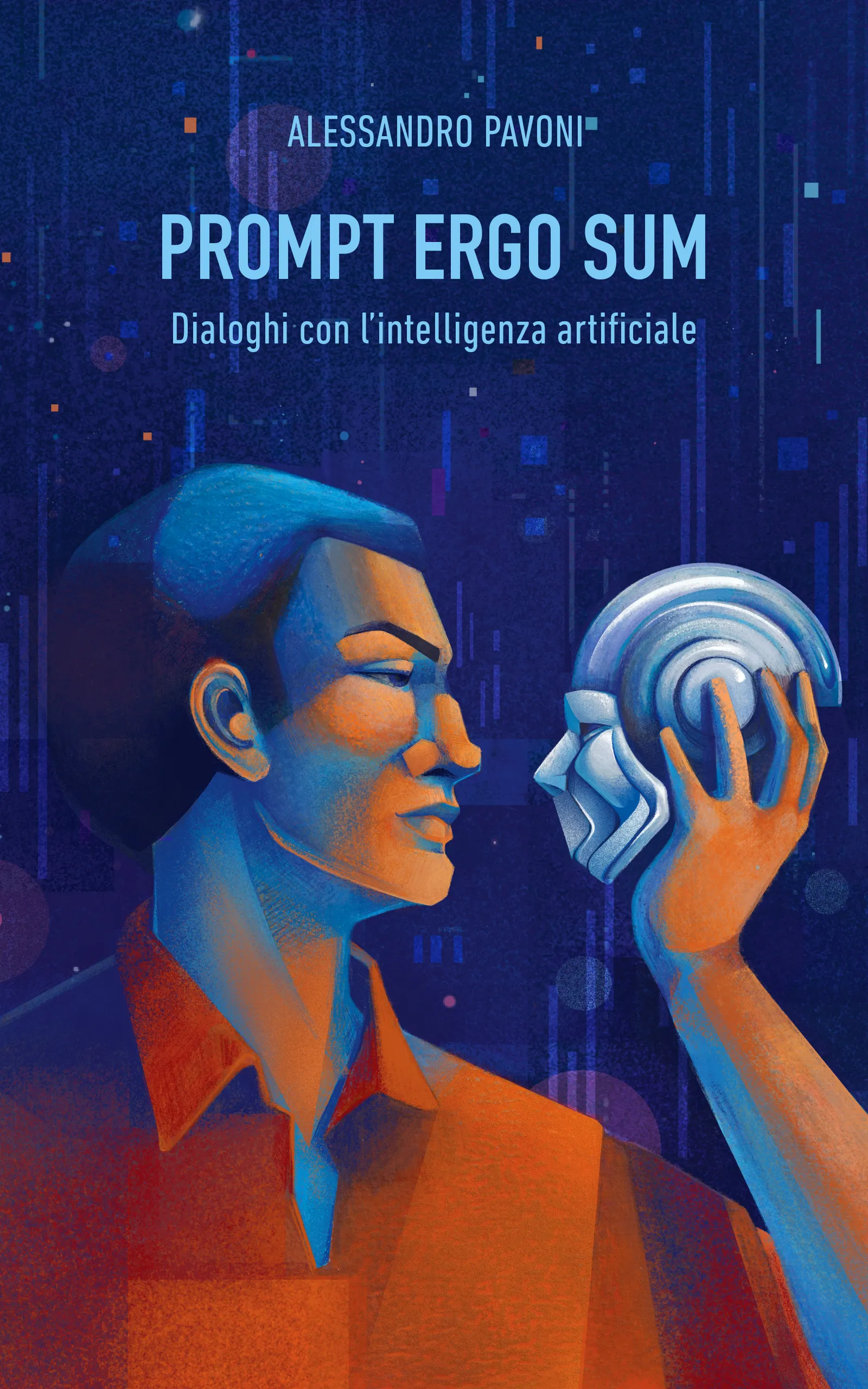
Prompt Ergo Sum
Dialoghi con l'intelligenza artificiale
An invitation to question how we engage with artificial intelligence and what that dialogue means for our thinking. Not a technical manual, but a reflective journey that explores the prompt as a linguistic and dialogic act, a space in which to refine the quality of our questions and develop a more conscious form of language.
For a long time we thought the value of artificial intelligence lay in the answers it generates. Prompt Ergo Sum starts from a different premise: the real point is not the quality of the answers we receive, but the quality of the questions we are willing to ask ourselves.
This is where the concept of computational maieutics emerges: when dialogue with AI ceases to be a request and becomes a mirror of thought.
A book for those who do not just want to learn how to use AI, but to understand what AI reveals about the way we think, decide, and shape meaning.
Prompt Ergo Sum Dialoghi con l'intelligenza artificiale
Prompt Thinking
A publication on Substack. Each essay is long, considered, published when the argument requires it. No hot takes, no link round-ups, no “five things I learned this week”.
What Is Still Worth Teaching?
The real revolution is not about what a machine can do. It is about what we will continue to ask of human beings.
For centuries, school administered the scarcity of knowledge. Now that answers are abundant, value shifts to what remains rare: the question, and the judgment to choose it.
Whoever Writes the Metric Owns the Future
Argentina is moving to hand AI a legal key. The whole debate skips the only question that matters: who writes the metric by which intelligence is measured?
The Rerum Novarum of the Algorithmic Age
What a papal encyclical on artificial intelligence reveals about who gets to write the moral code of the age that is coming
The problem is no longer whether AI will become powerful. The problem is who will possess the right to write the moral code of the age that is coming.
The End of Indispensability
Artificial intelligence is not erasing the value of the tech class — it is showing who had real competence and who was living off a scarcity rent
For years we confused scarcity with value. AI does not break the monopoly by proving itself superior — it breaks it by making a measurable, comparable, debatable alternative exist.
When Everyone Can Sound Competent
Artificial intelligence and the new crisis of authority
When everyone can produce fluent, confident prose on demand, fluency stops being a signal. The crisis is not of language but of authority — of how we tell who is worth listening to.
The New Politics of Technology
How the relationship between power, responsibility and technology is beginning to redefine our collective destiny
When technology stops being a tool and becomes a trajectory, responsibility tends to dissolve. The same mechanism that fuelled every arms race in modern history.
Computational Maieutics
When dialogue with artificial intelligence ceases to be a request and becomes a mirror
Not because the machine is intelligent — but because the precision it demands forces thought to expose itself. The founding piece of the framework.
The Value AI Can't Replace
Why the future of work may become unexpectedly physical
As cognitive work becomes increasingly scalable, certain forms of skilled manual work remain inherently non-scalable — not because they are simpler, but because they require direct interaction with the physical world.
The New Competitive Advantage Is Human
Why artificial intelligence is reshaping the value of the humanities
As models become capable of producing language and simulating reasoning, the economic value of raw knowledge production diminishes. What rises in scarcity is something more subtle: interpretation, contextualisation, judgement.
Before It's Too Late
What we choose today will shape how we live with AI tomorrow
Not all transformations can be corrected after the fact. Some, once normalised, stop being decisions. They become environment.
When Language Stops Being Neutral
Why responsibility moves upstream in the age of AI
When decisions are mediated by technology, responsibility does not sit at the point of execution. It sits at the point of formulation. What did we ask, and how did we ask it?
The Historian's Craft in the Age of Artificial Intelligence
From Marc Bloch to predictive models — rethinking memory, narrative and historical responsibility in the algorithmic era
In the past, history risked being told by the victors. Today, it risks being written by models. AI is not neutral — when it enters the realm of history, it brings the ambition of objectivity but also the danger of invisibility.
SOSTA
On taste, provenance, ritual and hospitality
SOSTA is the editorial form of the register of pleasure: an independent publication on taste, provenance, ritual and hospitality. It emerges from a sedimentation built over years and from a conviction: the more the world accelerates, replicates, and dematerialises, the more what demands presence, time, attention, and care comes to matter again. Not reviews, not scores, not trends. SOSTA observes food, wine, places, people, objects, and gestures to understand what they tell, what knowledge they embody, which territory they interpret, what memory they leave behind. The Manifesto defines its scope. Issue 00 opens the first editorial field.